
AI Is Changing Everything Faster Than We Expected
Just a few years ago, artificial intelligence (AI) felt like a futuristic concept reserved for researchers and tech companies. Today, AI is everywhere. It powers search engines, virtual assistants, translation tools, content creation platforms, coding assistants, image generators, and increasingly, the way we learn.
Tasks that once required years of expertise can now be completed with AI support in a matter of minutes. As a result, many people are asking the same question: Will AI replace us?
The more important question, however, is not whether AI will replace humans, but how humans can adapt and thrive alongside AI.
AI is transforming not only how we work, but also how we learn. In this new era, the ability to keep learning may be the most valuable skill of all.
The Most Successful Learners Won't Be Those Who Know the Most
In the past, having a large amount of knowledge was a major advantage. Today, AI can retrieve and summarize enormous amounts of information in seconds.
The real competitive edge is no longer how much information you can memorize. Instead, it comes from your ability to:
- Learn quickly
- Adapt to change
- Ask better questions
- Think critically
- Use technology effectively
In other words, lifelong learning has become one of the most important skills of the 21st century.
People who continue learning will use AI as a powerful tool. Those who stop learning risk falling behind as technology continues to evolve.
Why English Is Becoming a Superpower in the AI Era
One of the most important skills for anyone who wants to stay relevant in the age of AI is English.
Many people overlook a simple fact: most of the world's newest knowledge is created and published in English first.
Scientific research, technology documentation, online courses, business insights, and AI innovations are overwhelmingly produced in English before being translated into other languages.
Without English skills, learners often have to wait for translated versions or second-hand summaries. By the time that information becomes available, they may already be behind those who can access the original source directly.
As AI continues to accelerate the pace of innovation, this gap may become even wider.
People who speak English can:
- Learn directly from global experts
- Access emerging technologies earlier
- Discover international career opportunities
- Communicate with clients and partners worldwide
- Use AI tools more effectively
English is no longer just another subject in school. It has become a gateway to knowledge, innovation, and global opportunities.
Is Traditional English Learning Still Enough?
Many learners spend years studying vocabulary and grammar yet still struggle to communicate confidently.
The reason is simple: traditional learning methods often focus on memorization rather than actual language use.
The true purpose of learning English is communication.
You don't learn English to pass exams forever. You learn it to:
- Have meaningful conversations
- Understand international resources
- Join global learning communities
- Work with international teams
- Access better career opportunities
This is why modern language learning is increasingly shifting from passive study toward active communication practice.
How AI Is Transforming English Learning
Not long ago, improving your spoken English often required:
- A private tutor
- Language classes
- Study partners
- Native speakers to practice with
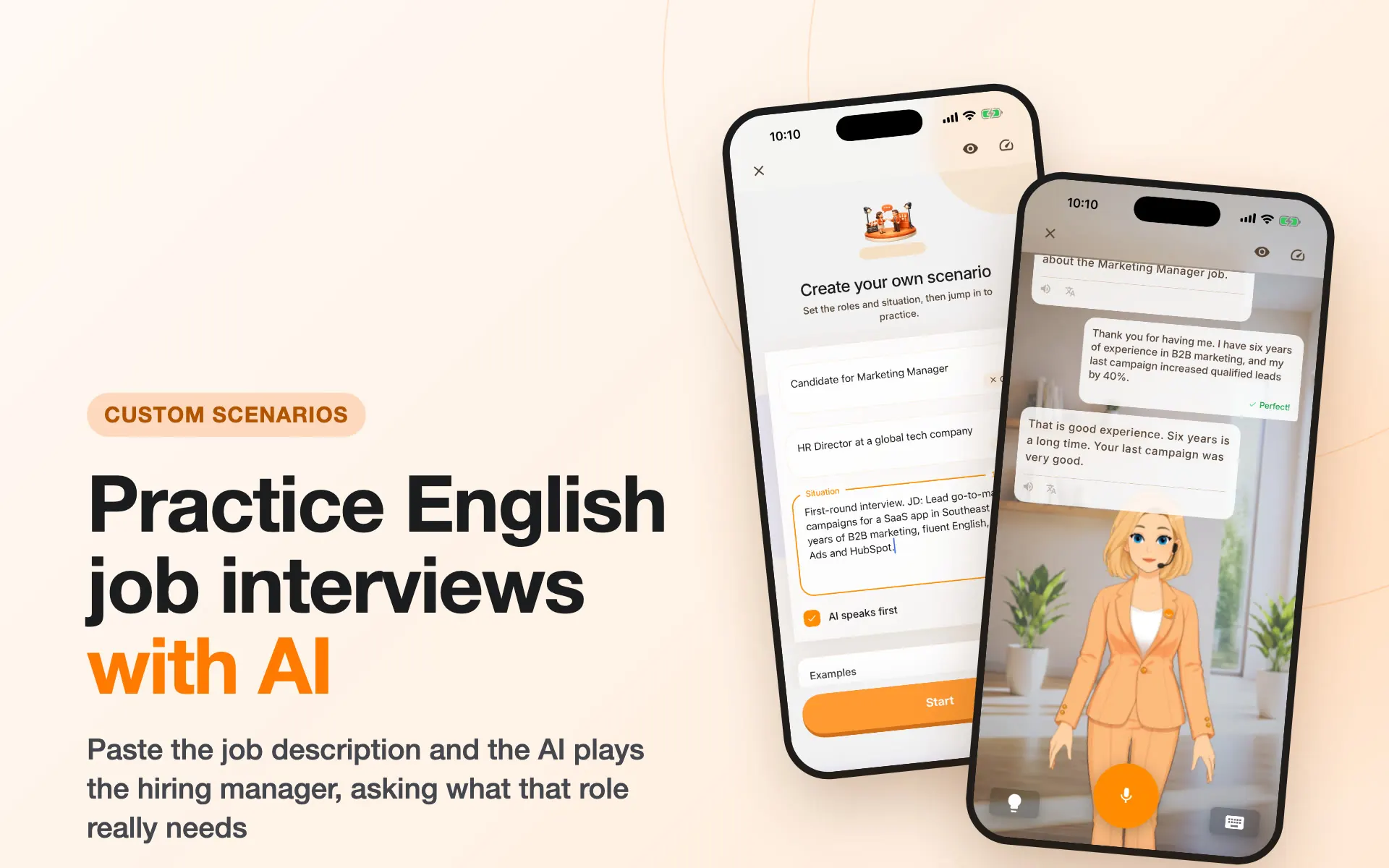
Today, AI can serve as a conversation partner available 24 hours a day.
Learners can:
- Practice speaking anytime
- Improve pronunciation consistently
- Receive immediate feedback
- Learn at their own pace
- Follow personalized learning paths
Perhaps most importantly, AI removes one of the biggest barriers to language learning: the fear of making mistakes.
Instead of waiting for a weekly lesson, learners can practice every day, build speaking confidence, and develop natural communication skills much faster.
Essential Skills to Develop in the Age of AI
While English remains a key advantage, there are several other skills worth investing in.
1. Lifelong Learning
Technology evolves rapidly. Skills that are valuable today may become outdated in just a few years.
The people who succeed in the future will be those who continuously update their knowledge and adapt to change.
2. Communication Skills
AI can process information, but human relationships still rely on communication, empathy, persuasion, and collaboration.
These abilities remain difficult to automate and highly valuable in every industry.
3. Critical Thinking
AI can generate answers, but it cannot always guarantee accuracy.
The ability to evaluate information, verify sources, and make informed decisions remains a uniquely human responsibility.
4. Learning How to Work With AI
Rather than fearing AI, people should learn how to use it effectively.
Those who know how to collaborate with AI will often achieve significantly higher productivity than those who choose to ignore it.
The Future Belongs to Those Who Keep Learning
Every technological revolution creates two groups of people.
The first group resists change and tries to hold on to familiar ways of working.
The second group embraces change, learns new skills, and takes advantage of new opportunities.
History consistently shows that the second group is the one that thrives.
In the age of AI, education no longer ends when you leave school. Learning is a lifelong journey.
And if there is one skill worth prioritizing today, English may be one of the best investments you can make. It not only helps you communicate with the world, but also gives you direct access to the knowledge, technologies, and opportunities that are shaping the future.
Conclusion
AI is not the enemy of human potential. It is a tool.
The real risk is not that AI becomes smarter than us. The real risk is that we stop learning while the world continues moving forward.
Treat AI as a partner in your learning journey. Use it to learn more efficiently, explore new ideas, and develop valuable skills.
And above all, invest seriously in English.
In an increasingly connected world, the ability to learn continuously and communicate in English may be one of the most important advantages you can have to stay ahead in the age of AI.