
In 2022 I joined an international company in Da Nang, Vietnam. Whenever I needed to talk to a foreign colleague, I turned to a Vietnamese colleague and asked them to say it for me. That went on for almost a year.
It wasn't that I had nothing to say. I knew the answer, in Vietnamese. What stopped me was the tight feeling every time I was about to open my mouth: afraid of saying it wrong, of sounding strange, of the whole room going quiet while I stumbled.
If you're afraid of speaking English, this post won't tell you to “just be confident.” I've never seen that advice work on anyone. It covers what the fear actually is, why it doesn't vanish after one brave moment, and the steps I went through. It's part of my series on how to practice English speaking with AI, but AI is only one of those steps.
Why Are You Afraid of Speaking English When You Can Read It Fine?
You fear speaking English because speaking is where you're exposed: no time to fix things like in writing, and every mistake is heard instantly. The fear usually comes from worrying about being judged, not from lack of knowledge. And because you speak less, each attempt goes worse, which makes you more afraid.
In 1986, Elaine Horwitz, Michael Horwitz and Joann Cope described foreign language anxiety in The Modern Language Journal and split it into three parts. You'll probably recognize all of them from your working life:
- Communication apprehension: an online meeting, everyone muted, every face on screen waiting for you. Even the simplest sentence feels hard.
- Fear of negative evaluation: plenty of people worry more about colleagues from their own country hearing their mistakes than about native speakers. Native speakers usually just want to understand you. People from home, you suspect, are noticing every error.
- Test anxiety: every sentence feels like a quiz with one right answer. If you were ever called to read aloud in class and corrected in front of everyone, you know the feeling.
I had all three. The second was the worst, because the person speaking for me was a Vietnamese colleague, and I assumed they knew exactly how bad my English was.
Fear Doesn't Disappear After One Brave Moment
The most common advice is “just speak, don't be afraid.” It sounds like there's a day when you take a deep breath, say one sentence, and you're cured. I never had that day.
Someone once asked me about my most embarrassing mistake. I couldn't answer. When I started, every time I spoke I got something wrong and felt embarrassed, so no single time stood out. The fear wasn't defeated. It wore down, because I made mistakes so often that they stopped feeling like a big deal.
Research points the same way. In 2019, Teimouri, Goetze and Plonsky pooled 97 studies covering almost 20,000 learners in 23 countries (published in Studies in Second Language Acquisition). They found a moderate link: the more anxious the learner, the lower their language results. But the authors also say it isn't clear which causes which. Fear makes you speak worse, and speaking badly makes you more afraid.
So you don't have to wait until the fear is gone before you speak. Speak more and you get better, and getting better makes you less afraid. The loop turns both ways. Your job is to keep pushing it the right way, a little every day.
What a Stumbling Job Interview Taught Me
In August 2022 I interviewed for that same company over video call. The English part was just introducing myself, my age, my experience. I still stumbled and hesitated the whole way through. I got the job anyway.
At the time I thought I'd been lucky. Later I understood: people care about what you say far more than whether your grammar is perfect. The company needed an engineer who could solve problems, not a newsreader. What I was afraid of (being graded on every mistake) was much bigger than what actually happened.
Three years later, before my second interview, where I'd have to present and solve problems entirely in English with a German CEO, face to face, I told myself one thing: if I keep being afraid, I'll never really be able to talk in English. That wasn't the moment the fear left. It was the moment I decided to speak while still afraid.
5 Steps to Overcome Your Fear of Speaking English
This is the path I actually took, ordered from least to most pressure. Don't skip steps. Stay on each one until it starts to feel a bit boring, then move up.
- Talk out loud on your own
- Talk to an AI, where nobody judges you
- Talk to one patient person you know
- Talk in a small group
- Talk where it really counts: work, interviews
Step 1: Talk out loud on your own
Describe your day in English, out loud, when you're alone. Nobody's listening, so fear of judgment is close to zero, and the only thing left to deal with is finding the words.
When I started at that company, every English video report took me over an hour of saying things again and again and listening back to my own voice. Hearing yourself speak English for the first time is uncomfortable. By the twentieth time it isn't. How to practice speaking English alone at home has specific exercises for this step.
Step 2: Talk to an AI, where nobody judges you
Talking alone means nobody answers back. Step 2 adds exactly one thing: someone replies, but it's not a person.
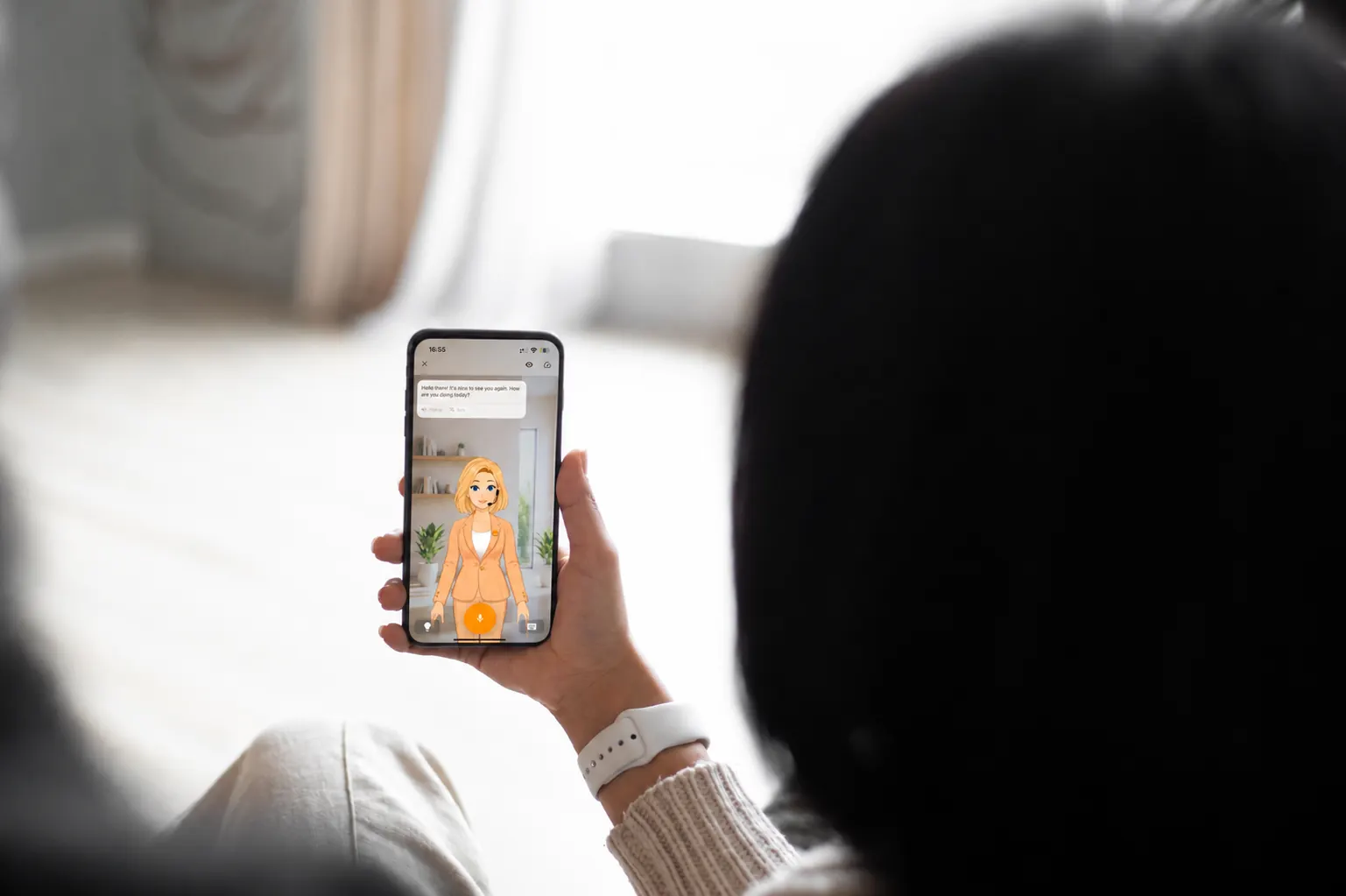
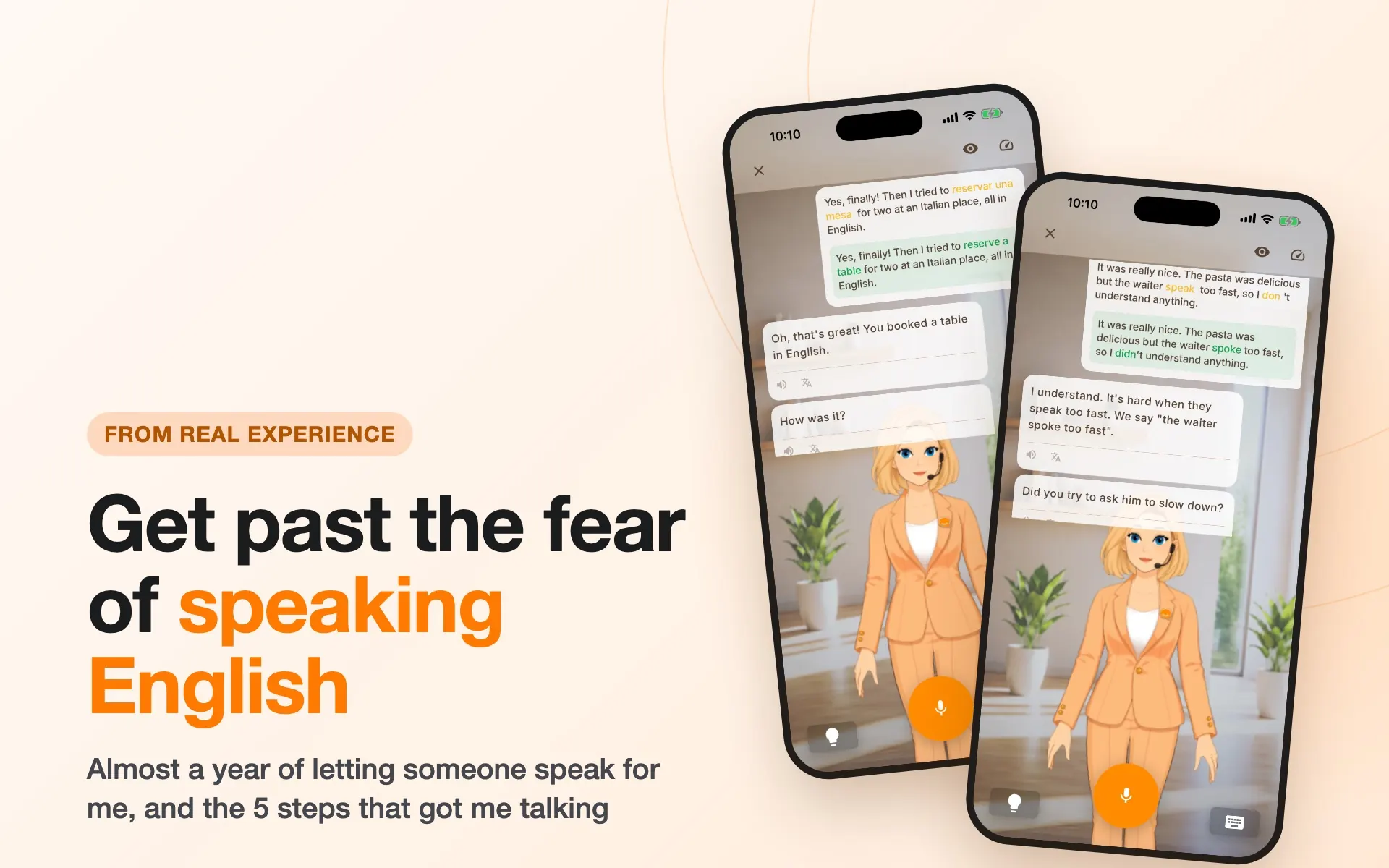
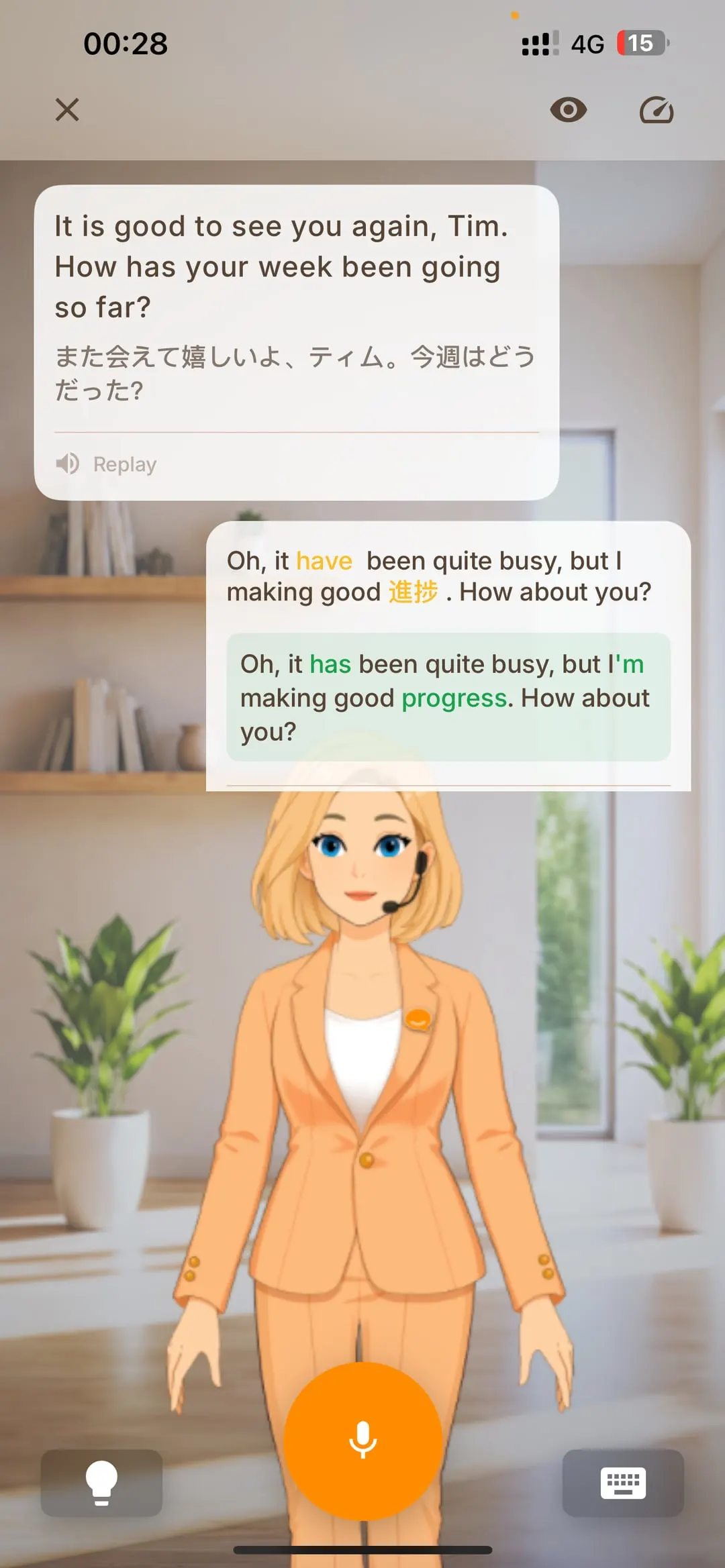
Part of why I built Chamate is that this step was missing when I was teaching myself. An AI doesn't frown when you get it wrong or sigh when you hesitate. In Chamate the mic is tap to speak, tap again to send, so the AI never jumps in while you're thinking. Stuck on a word? Drop in a word from your own language and Chamate rewrites the sentence in natural English so you can keep going. Grammar mistakes get corrected, but as a note you can review, not a judgment in the middle of your sentence.
It's easy to stay on this step too long, because it's comfortable. In my view, AI is about 90% as natural as a real person. That's enough to train your reflexes and get used to opening your mouth, but it's a stepping stone. Once you can talk for 10 minutes straight without freezing, move to step 3.
Step 3: Talk to one patient person you know
For me that was a friend who teaches English. I kept speaking English with my friend even though I was terrible at it: wrong tenses, awkward pauses, no idea how to describe simple things. Friends rarely bother pointing out every grammar mistake. That's a weakness if you're trying to learn grammar, but it's exactly what you need to get past the fear: you practice carrying on even when you know you got it wrong.
Choosing the person matters more than choosing the topic. Pick someone who knows you're learning, doesn't interrupt, doesn't laugh. Avoid anyone who makes you feel tested, even if their English is better.
Step 4: Talk in a small group
An English club, a few colleagues who use English, an evening out with foreign friends. A group is harder than one-on-one because more people are listening, but easier because you don't have to talk the whole time. You can listen a lot, add one sentence, then listen again.
I slowly got closer to a few colleagues who used English, went out with them, joined an English club. After about two months of talking almost every day like that, my reactions were noticeably faster, and the fear shrank at the same pace.
Step 5: Talk where it really counts
A meeting, a client call, a job interview. At this step the fear is still there, and a little of it should be. The difference is that you've spoken enough times to know you'll get through it.
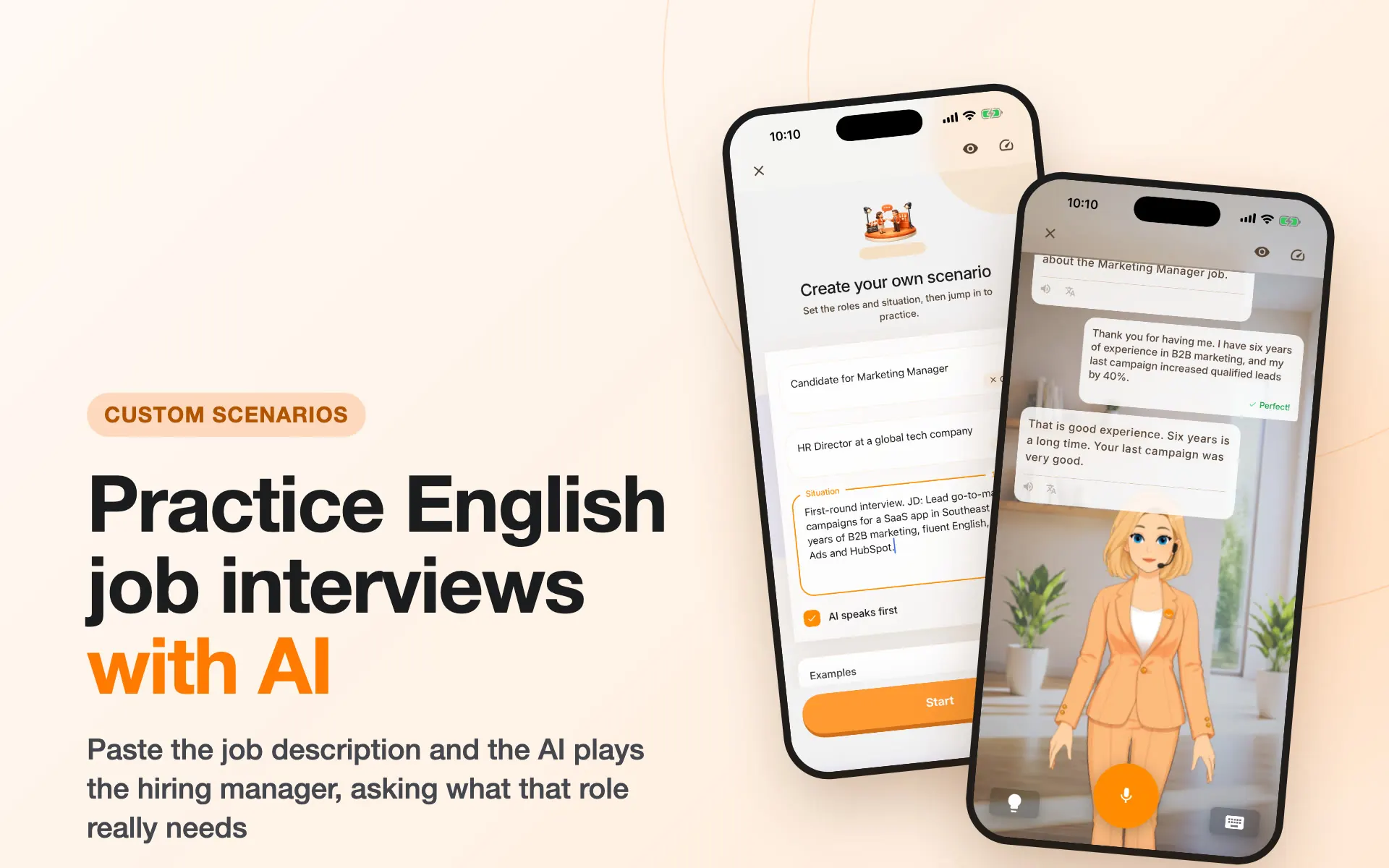
Before my 2025 interview, I spent time imagining every scenario that could come up and practiced each one on my own. Chamate didn't exist yet, so I practiced alone and then with the recruiter. Now you can set up that exact interview with AI. See practicing an English job interview with AI.
Phrases for When You Freeze Mid-Sentence
A lot of the fear is fear of the silence: you didn't catch something, you forgot a word, you made a mistake halfway through. Have a few phrases ready for those moments and the silence stops being scary. Learn these and say them out loud a few times before you need them.
| When you… | Say |
|---|---|
| Didn't catch what they said | Sorry, could you say that again a bit slower? |
| Need a few seconds to think | Let me think for a second. |
| Forgot a word | What's the word… it's the thing you use to… |
| Want to know how to say something | How do you say “…” in English? |
| Just said it wrong | Sorry, I mean… |
| Don't know a word they used | Sorry, what does “…” mean? |
| Aren't sure they understood you | Does that make sense? |
Native speakers use these every day. Saying “let me think for a second” doesn't make you look worse. It makes you look like someone who's thinking, not someone who's panicking.
One more trick: when you're stuck, use shorter sentences. You wanted to say “the project is delayed because our partner sent the documents late,” but what comes out is “The project is late. The partner sent the documents late.” Two short sentences get the point across. How to speak English naturally like a native speaker goes deeper on keeping it short and natural.
How Long Does It Take to Stop Being Afraid of Speaking English?
I can't give you a number. For almost a year I barely spoke for myself, because I was busy with engineering work and there was always someone to speak for me. Once I started speaking regularly every day, about two months was enough to make a clear difference. My strategy was persistence. There was no single turning point.
What matters isn't how brave you are but how often you speak. With one session a week, the fear has time to recover between sessions. With fifteen minutes a day, it doesn't. If you want a concrete routine, I wrote one up in how to practice English speaking with AI in 15 minutes a day.
And if your fear goes as far as freezing completely, mind blank mid-sentence, that's a slightly different problem with its own fixes. I cover it in why you freeze when speaking English even after years of study.
When the Fear Needs More Than Practice
Feeling a bit shaky before an English meeting is normal. But if you lose sleep for nights before a call, turn down opportunities you actually want, or feel the same dread speaking your own language in front of a group, it may be social anxiety rather than an English problem. Talk to a doctor or a mental health professional. A speaking app, Chamate included, can't replace that.
Start Below the Fear
Today I use English at work more than Vietnamese, with colleagues in Germany, India and the US. It comes naturally, without effort. I don't remember the day the fear went away. At some point it just stopped standing in front of every sentence.
You don't need to stop being afraid before you start. You start at the lowest step you can manage, today. Tonight, describe your day out loud for two minutes. If you want someone to answer without anyone judging, you can download Chamate and say your first sentence right now.