
On this page
I've learned English three ways. In 2022, fresh back in Vietnam after five years in Russia and starting at an international company, I taught myself with books, movies and YouTube. Then I had people to talk to: a friend who teaches English, a few colleagues, an English club. These days I build an AI tutor.
So when someone asks whether an AI English tutor can replace a human one, I can't give the marketing answer. I know where AI beats people, because that's why I started Chamate. I also know where it falls short, because I learned from real people first.
This post is part of a series on practicing English speaking with AI. It answers one question: should your time and money go to AI, to a teacher, or to both?
The Short Answer
No, an AI tutor can't replace a good teacher. But it can replace most of the speaking practice you used to need another person for: saying things over and over, getting every sentence corrected, practicing at midnight, making mistakes without feeling embarrassed. You still need a teacher for what AI doesn't do well yet: spotting the mistake you've made for months, building a plan, exam prep, and the real pressure of someone listening.
Put simply, AI replaces practice hours. It doesn't replace the teacher. The rest of this post is the detail you need to decide for yourself.
The Three “Teachers” I've Learned From
Studying alone: knowing a lot, saying nothing
At first it was vocabulary, grammar, films and shadowing. My vocabulary grew and my pronunciation got clearer. Then I'd sit in a meeting with my overseas colleagues and catch two or three words per sentence. When it was my turn, nothing came out. Studying alone taught me to recognize words, not to use them. I wrote about that stage in why you freeze when speaking English.
Real people: the turning point, when you can get them
Things only changed once I was talking regularly with a few friends at work, a friend who teaches English, and an English club. About two months in, I was answering noticeably faster. No textbook did that for me.
Here's the part people leave out: most of my practice still happened alone at home. My teacher friend helped a lot early on, but we couldn't meet often. Everyone was busy.
Learning with friends has other problems nobody likes to say out loud. Speaking English over drinks by chance is fine. Turning it into a weekly favor is different, and sooner or later people stop wanting to do it. You can't ask someone to repeat a sentence for the fifth time. And honestly, friends don't really bother catching your grammar mistakes. Correcting someone all evening is exhausting.
AI: what I wish I'd had from the start
In 2025, before an interview with a German CEO, I tried practicing with ChatGPT. It talked too fast and kept jumping in while I was still thinking, so I ended up practicing on my own and then with my recruiter. I remember wishing there were an AI built for learners. That wish is where Chamate came from. (I compare ChatGPT and a dedicated app in practicing English speaking with ChatGPT.)
Where an AI English Tutor Beats a Human
It repeats itself as often as you like
With a person, you feel awkward asking for the same sentence a third time. With AI, you can hit replay ten times and nobody sighs. You can also slow its speaking speed down and pick a level so it uses words and sentences you can handle. Hearing one sentence many times at a speed you can follow is how your ear gets used to real English.
It corrects every sentence and never gets tired
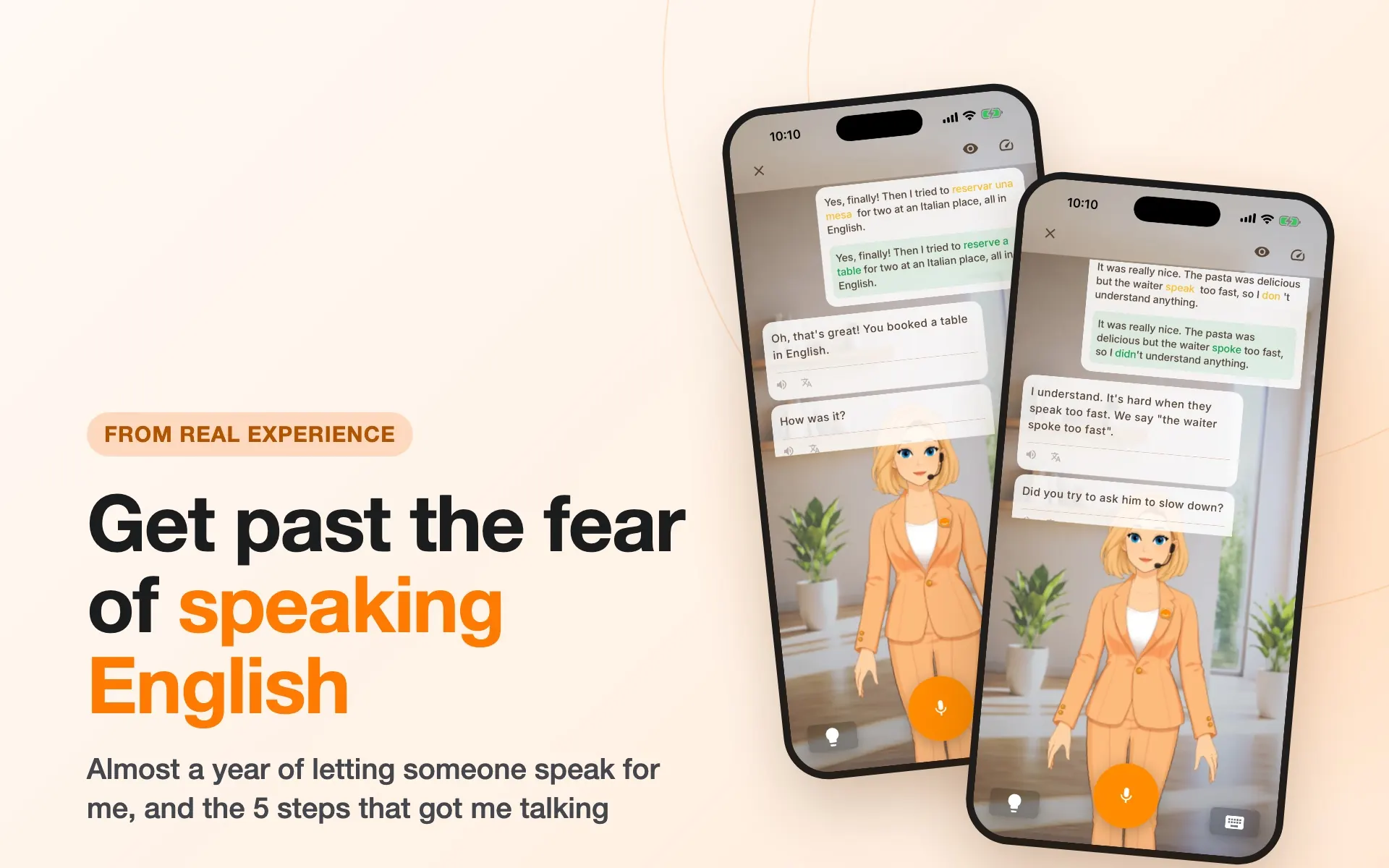
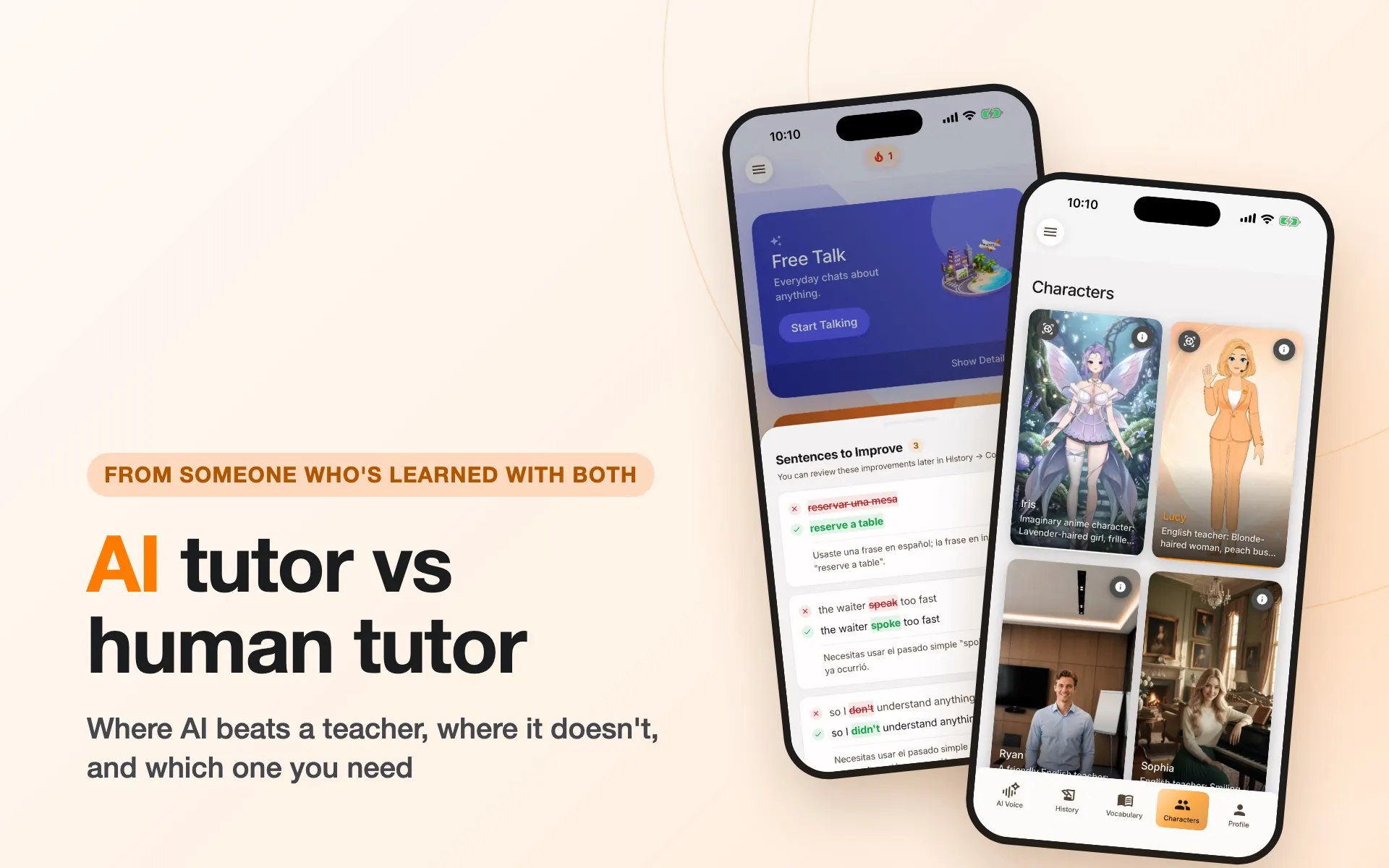
This is the biggest difference from practicing with friends. AI can flag the mistake in every sentence you say and give you a corrected version, from the first line to the last, without skipping any to keep the mood light. After the session, the sentences that need work are collected so you can review them.
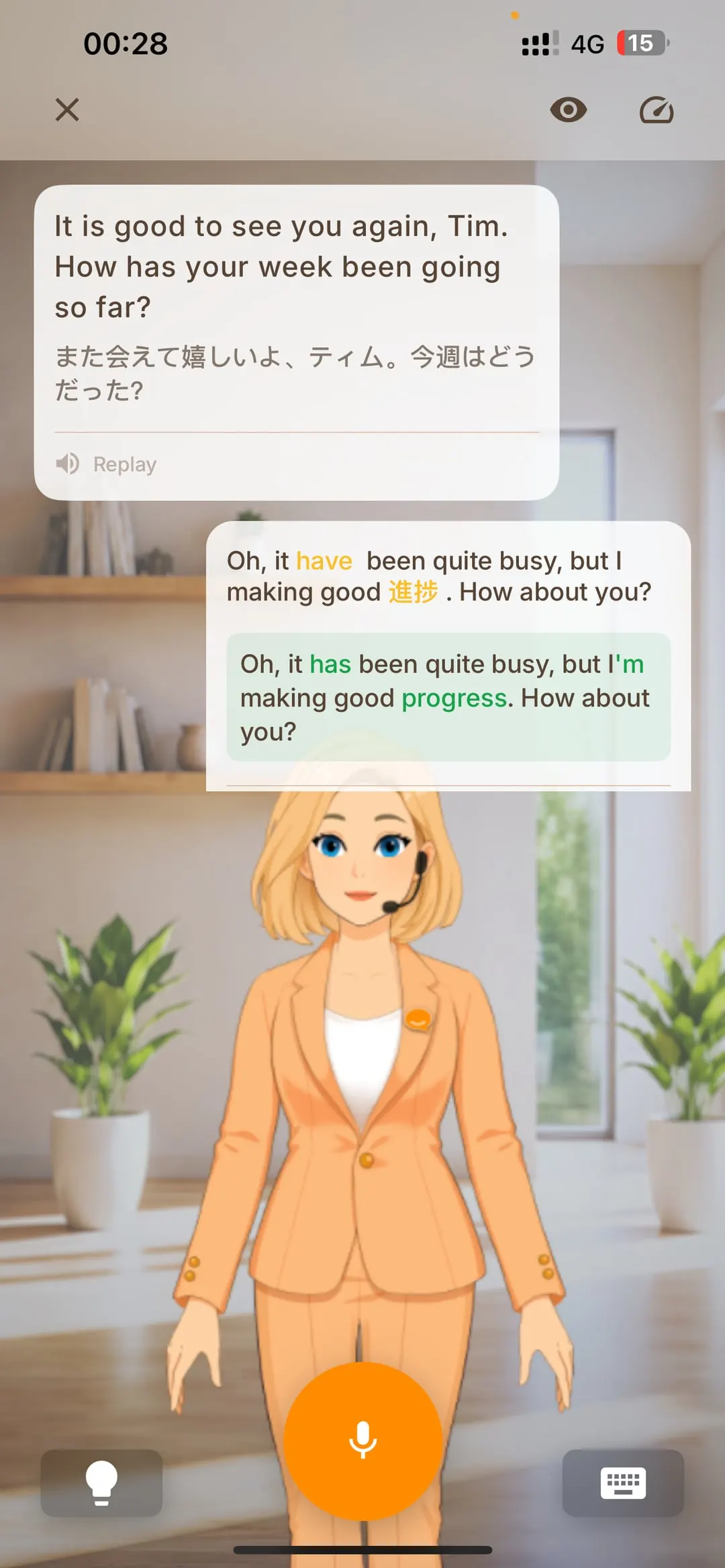
And if you get stuck on a word, you can say it in your own language. In the screenshot below, a learner drops in the Japanese word for “progress” mid-sentence, and Chamate hands back natural English with the word in place. A teacher can do this too. Very few will do it for every sentence, every day.
It's there when you actually feel like practicing
If you work, you rarely feel like studying at exactly 7 p.m. on Tuesday because that's when your tutor is free. The urge hits at 11 at night, or on a 15-minute bus ride. An AI tutor is there then, and those small moments are what add up to a habit.
Nobody watches you get it wrong
A lot of learners don't lack knowledge. They lack nerve. In front of a person, especially a teacher, your heart speeds up and your sentences shrink. With AI, the fear of being judged gets a lot smaller.
There's research behind that feeling. In 2025, Chenghao Wang and Bin Zou of Xi'an Jiaotong-Liverpool University compared three ways of practicing speaking with 103 English learners in China: with AI, with teachers and with peers. Their study in the journal IRAL found the AI group improved more than the other two in speaking performance, willingness to communicate, and how confident learners felt about their own speaking. In interviews, learners said they felt more relaxed and secure talking to AI.
Read it at the right size. It's one study, with one group of learners, about speaking practice. It isn't proof that AI teaches better than teachers. But it matches what I've seen: people talk more when they're not afraid. If fear is what's holding you back, read how to overcome the fear of speaking English.
What a Good Teacher Does That AI Can't Yet
My own sense is that talking to AI now feels about 90% as natural as talking to a person. That's my opinion, not a measurement. The missing 10% is real, though, and it lives in these places.
Spotting the mistake you've made for three months
AI is very good at fixing one sentence at a time. A good teacher listens to you for a few sessions and says: your problem isn't the past tense, it's that you're translating everything from your first language. Then they change how you practice. Seeing patterns across months and planning around them is a teacher's job, and AI apps, Chamate included, can't do it for you yet.
The pressure of a real person listening
AI is comfortable because there's no pressure. That's also its limit. A real interview or a real meeting has someone looking at you, waiting. You only get used to that by practicing with people. AI gets you to the door. Walking into the room is something you do with real people.
Everything that isn't in the textbook
I work every day with colleagues from the US, Germany, Italy, India and Taiwan, and each of them speaks English differently. When to be direct, how to make a joke land: none of that is in a course book. A teacher who has lived and worked with people from other countries will teach you that through their own stories. AI knows a lot, but it doesn't have stories of its own.
Exams, scores, and keeping you from quitting
Chamate doesn't score your pronunciation and doesn't give IELTS band scores. To know your band, you need real practice tests or a teacher who has examined. I cover what AI can and can't do for the test in practicing IELTS Speaking with AI.
One more thing people forget: having someone who expects you every Thursday makes it harder to quit. An app can send you a reminder, but ignoring a notification is a lot easier than standing someone up.
AI Tutor vs Human Tutor vs Friends: Side by Side
| AI tutor | Teacher or 1-on-1 tutor | Friends, English club | |
|---|---|---|---|
| When you can practice | Any time | By appointment | When you're both free |
| Cost | Usually a monthly plan | Per hour, the most expensive | Almost free, but uses up other people's goodwill |
| Corrects every sentence | Yes, all of them | Yes, during the lesson | Rarely |
| Repeats and replays | Unlimited | A few times | You feel awkward asking |
| Spots recurring mistakes, plans your path | Weak | Strongest | No |
| Real pressure when speaking | Almost none | Yes | Yes |
| Culture, nuance, real stories | General knowledge | Yes | Yes |
| Exam scoring | Chamate doesn't score | Yes (if they've examined) | No |
| Embarrassment when you get it wrong | Lowest | Highest | Medium |
AI Tutor or Human Tutor? It Depends Where You Are
- Beginner and nervous about speaking: start with AI. Getting a few hundred sentences wrong in front of something that doesn't judge is far easier than doing it in front of a stranger. Once the words come more easily, add real people.
- Working full time: 15 minutes with AI every day gets you more speaking time than one weekly lesson you keep rescheduling.
- Preparing for IELTS or another speaking test: you need both. AI for daily practice so you speak fluently, a teacher or real practice tests to measure your band and learn strategy.
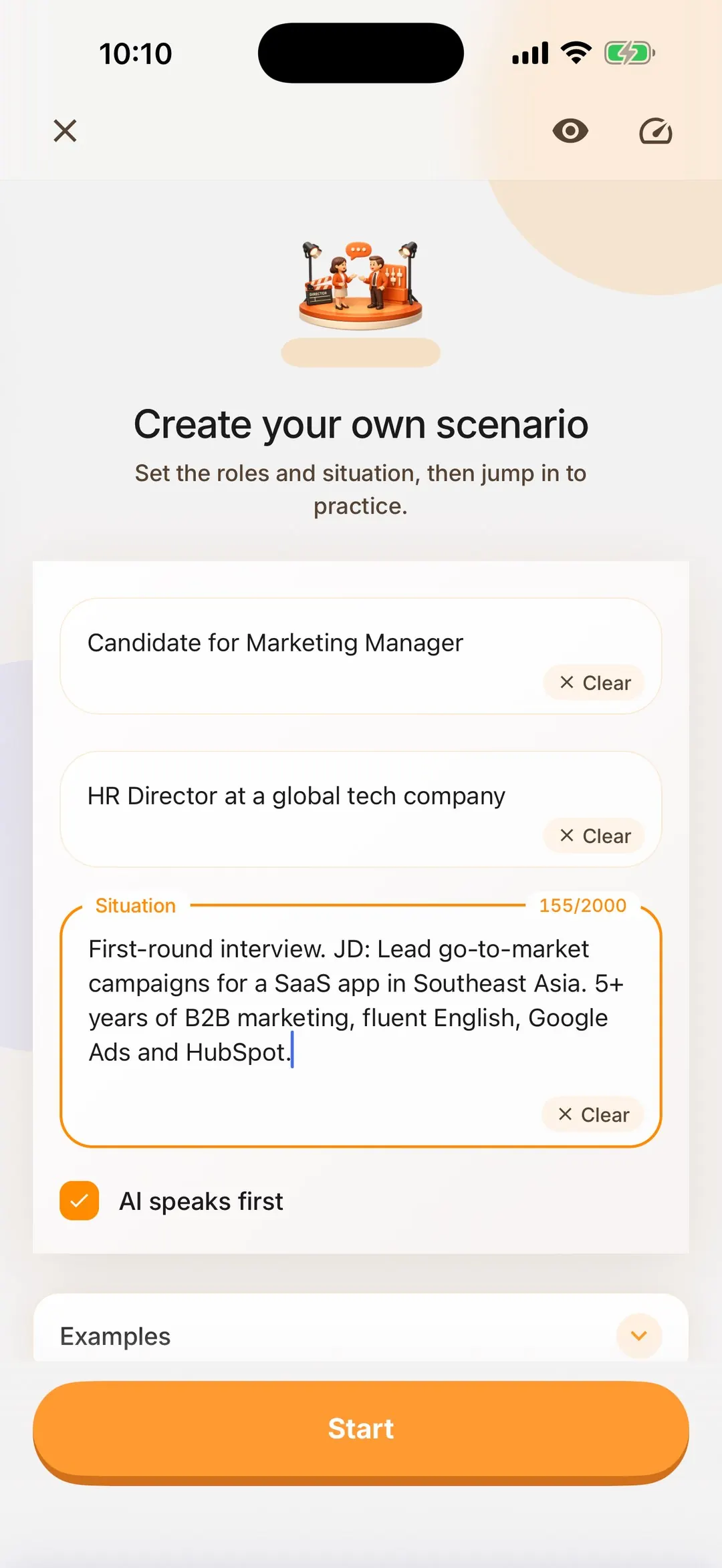
- Interviewing in English soon: rehearse with AI several times using the actual job description, then do one session with a real person before the day. My method is in practicing for an English job interview with AI.
- Already fairly fluent and want more: you need people more than AI now. A good teacher to catch the habits you no longer notice, and real conversations to get used to pressure. AI becomes the place to prepare for important conversations.
How to Combine Them: A Sample Week
If I could start over in 2022, this is the schedule I'd follow:
| When | What | With whom |
|---|---|---|
| Every day, 15 minutes | Talk through one topic, review the sentences that need fixing | AI tutor |
| Once a week or every two weeks | Bring the mistakes AI flagged and ask about the patterns | Teacher or tutor |
| Weekends, when you can | Unplanned conversation | English club, colleagues, friends |
| Before something important | Rehearse that exact situation several times | AI tutor, then one real person |
A small tip: a lesson with a teacher is the most expensive hour you have, so don't spend it on things AI can do. Show up with a list of sentences you keep getting wrong, and your teacher can use the time for what only they can do. The minute-by-minute daily routine is in how to practice English speaking with AI in 15 minutes a day.
So Will AI Replace English Teachers?
I don't think so, but the job will change. The repetitive part, like listening to a student say the same sentence five times or fixing the same mistake for the tenth time, AI does more cheaply and more patiently. The human part stays: diagnosing, planning, telling real stories, keeping learners from giving up. A good teacher whose students have practiced with AI all week can teach a lot more in one hour.
For me, AI is a stepping stone to talking with real people. It's not a place to stay forever.
Final Thoughts
If you can only pick one, for most learners I'd pick AI first. Not because it's better than a teacher, but because what most people lack is hours of actual speaking, and AI gives you exactly that at the lowest cost. Once you can talk, go find real people.
Want to try your first 15 minutes? Download Chamate and talk to the AI today. Then take the sentences it corrects to your next lesson or club meetup. If you'd rather learn step by step first, Chamate also has a full A1 to B2 path (see what's inside).
Frequently Asked Questions
Can an AI English tutor replace a human teacher?
Not completely. An AI tutor can replace most of your speaking practice: unlimited repetition, corrections on every sentence, practice at any hour. You still need a teacher to spot recurring mistakes over months, plan your learning, prepare you for exams, and give you the pressure of a real listener.
Does learning English with AI actually work?
For speaking, there's good evidence. Wang and Zou (2025, IRAL) compared 103 learners in China and found that those who practiced with AI improved more in speaking performance and willingness to communicate than those who practiced with teachers or peers. It's one study, so treat AI as a place to practice speaking, not a replacement for all teaching.
Should a beginner learn with AI or with a teacher?
If you're nervous about speaking, start with AI so you can get comfortable without being judged. If you need a grammar foundation and a clear plan, a good teacher helps a lot early on. The best setup is AI every day plus a session with a real person every week or two.
Can an AI tutor correct my pronunciation?
It depends on the app. Chamate corrects grammar and vocabulary and lets you replay model sentences as often as you like, but it doesn't score pronunciation. To check your pronunciation, record yourself or ask a teacher.
Is an AI tutor cheaper than a private tutor?
Usually, yes. Private tutors charge by the hour, while AI apps usually charge a monthly plan and let you practice every day. A lesson with a teacher gives you things AI can't yet, so use it for diagnosis and planning, not repetition.