
On this page
In 2022, when I'd just started at an international company, I taught myself English with whatever I could find: books, films, YouTube. And shadowing, listening to a sentence and repeating it exactly. A few months in, my pronunciation was noticeably clearer.
Then I sat in a meeting with foreign colleagues. I caught two or three words per sentence. When it was my turn, nothing came out.
Shadowing wasn't wrong. My expectations of it were. This post covers what the shadowing technique is, how to do it properly, what it helps with and what it doesn't, so you can put it in the right place when you practice English speaking with AI or with anyone else.
What Is the Shadowing Technique?
Shadowing is a listening and speaking exercise: you hear a sentence in English and repeat it almost immediately, copying the sounds, stress, rhythm and intonation, like a shadow following the speaker. It comes from interpreter training and became widely known among language learners through Alexander Arguelles, a researcher and prolific language learner.
There are two versions. Close shadowing: you speak over the audio, just slightly behind the speaker. Pause-and-repeat: you hear a whole sentence, pause, then say it back. Beginners should start with pause-and-repeat. Close shadowing is much harder, and if you try it too early you'll just be mumbling to keep up.
What Shadowing Helps With, and What It Doesn't
It helps: hearing sounds, and making them
Shadowing forces you to pay attention to sound, not just meaning. In 2016, Yo Hamada of Akita University in Japan had 43 university students practice shadowing and published the results in Language Teaching Research. The lower-proficiency group improved clearly on a basic listening test. The intermediate group showed no significant difference. Later reviews of this research explain that shadowing makes learners process each sound instead of guessing the meaning, which is why it helps most when your ear can't yet separate the sounds.
For many learners, that means final sounds and linking. “Works” comes out as “wor”, “asked” as “ask”, and “check it out” doesn't register as three words. Listening closely and repeating every sound is the most direct fix I know.
The speaking side works the same way. Back then, every English video report took me over an hour of saying things again and again, listening back, trying to get the pronunciation right. My mouth slowly got used to sounds Vietnamese doesn't have. By the time I needed to speak for real, my mouth wasn't the bottleneck anymore.
It doesn't help: coming up with your own sentences
This is where I got it wrong. Shadowing means repeating someone else's sentence. The sentence already exists, the words are already chosen, the grammar is already correct. In a conversation you have to come up with the idea, find the words and build the sentence yourself, in a few seconds, while someone waits. Shadowing doesn't train that.
That's how I ended up with decent pronunciation and still froze. My reactions only got faster once I started actually talking every day with friends and an English club, and after about two months it was a different story. I wrote about this in why you freeze when speaking English even after years of study.
My takeaway: shadowing is a workout for your ears and mouth. It makes conversation easier, but it doesn't replace conversation.
How to Do the Shadowing Technique: 5 Steps
Each step has a spot where people tend to go wrong. Read that part more carefully than the instructions.
- Pick a short clip with a transcript and one speaker
- Listen a few times and understand every sentence
- Listen, pause, repeat sentence by sentence
- Speak over the audio without the transcript
- Record yourself, compare, fix one or two things
Step 1: Pick a short clip with a transcript and one speaker
Three to five sentences is enough for one session. A transcript so you know exactly what's being said. One speaker so you're copying one voice, not three.
Where it goes wrong: picking a whole 18-minute TED talk because someone said “shadow TED talks.” You'll quit before minute three.
Step 2: Listen a few times and understand every sentence
Listen two or three times without speaking. Read the transcript, look up unfamiliar words, understand what each sentence means.
Where it goes wrong: skipping this because “shadowing is about sound, not meaning.” Repeating a string of sounds you don't understand leaves you with nothing to use later.
Step 3: Listen, pause, repeat sentence by sentence
Play one sentence, pause, say it out loud, looking at the transcript if you need to. If it's too fast, drop to 0.75x. Repeat that sentence until it flows, then move on.
Where it goes wrong: mumbling. Shadowing is training for your mouth, and if you speak too quietly your mouth learns nothing. Speak at the volume you'd use with someone across the table.
Step 4: Speak over the audio without the transcript
Once you know the clip, play it from the start and speak along with the speaker, half a beat behind. No transcript.
Where it goes wrong: chasing the speed and swallowing final sounds. Slow and complete beats fast and missing sounds. If you can't keep up, go back to step 3 for another day.
Step 5: Record yourself, compare, fix one or two things
Use your phone's voice recorder, say the whole clip, then listen to yours and the original back to back. Find the one or two biggest gaps: a dropped final sound, the pitch going up in the wrong place. Tomorrow, fix exactly that.
Where it goes wrong: listening back and hating all of it. Hearing your own voice speak English is uncomfortable for everyone at first. It was for me. By the twentieth time it isn't.
Choosing Material: Shadow What You'll Actually Say
The usual advice is to shadow films, TED talks, podcasts. I think it works better to shadow sentences you'll actually need this week. A sentence you practice and then use right away sticks far better than a beautiful line from a speech you'll never give.
| You need | Shadow this | Example |
|---|---|---|
| Meetings and work | Openers, asking for more time, status updates | Let me share my screen. / Could I have two more days for this? |
| Job interviews | Introducing yourself, describing your experience | I've been working as a backend developer for three years. |
| Daily life and travel | Ordering, asking for directions, checking in | Could I get the check, please? |
| Listening | Slow podcasts or short news for learners | A 30-second clip, not a whole episode |
What about accent? Don't aim to sound American. My colleagues in Germany, India, Italy and Taiwan all have their own accents, and we work together every day without trouble. The goal is to be understood the first time: complete final sounds, the right word stress, pauses in the right places. How to speak English naturally like a native speaker has more on sounding natural without changing your accent.
Shadowing With AI: Listen, Repeat, Then Use It
The biggest weakness of shadowing is that the sentences you practice aren't sentences you came up with. Here's how I'd connect the two: shadow inside a conversation, then use the sentence you just practiced in your reply.
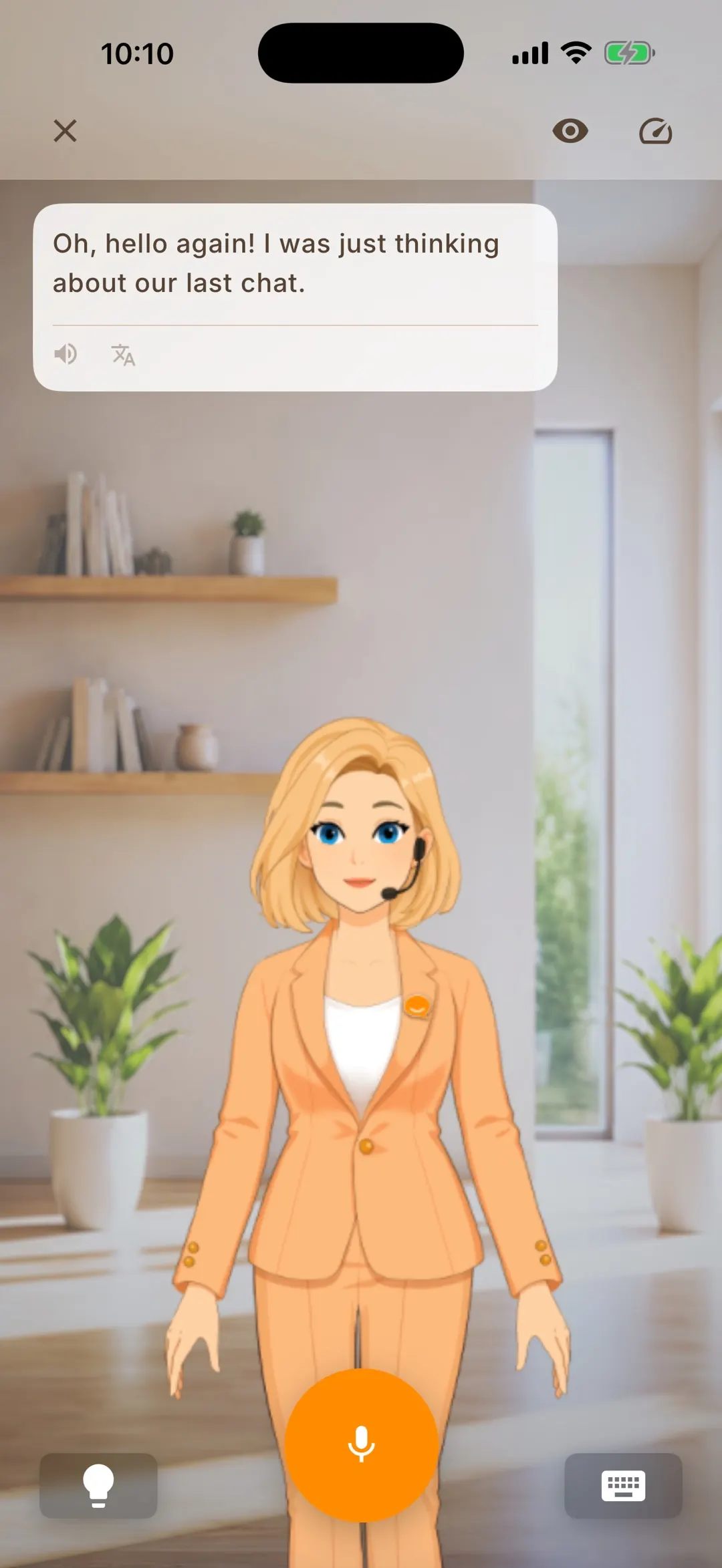
In Chamate, every AI message has a replay button and a translate button. When the AI says something useful, tap replay and say it along two or three times. If it talks too fast, lower the “Response speed.” When it's your turn and you're stuck, tap to show a suggestion: “You can say:” gives you a few sample sentences with translations, and a button reads the suggestion aloud. Listen, repeat, then use that sentence to answer.
Now the sentence you just shadowed is a sentence you said yourself, in a real conversation with context. That's the step shadowing alone with a video can't give you.
One thing to be clear about: Chamate doesn't score your pronunciation. To compare your voice with the original, you still need step 5 and your phone's voice recorder.
A 10-Minute Daily Shadowing Routine
Shadowing tires you out faster than you'd expect, because your ears and mouth are working nonstop. Ten minutes is about right:
- Minutes 0–2: listen to today's clip twice, read the transcript
- Minutes 2–5: listen, pause, repeat sentence by sentence
- Minutes 5–8: speak over the audio without the transcript
- Minutes 8–10: record the whole clip, compare, pick one thing to fix tomorrow
Stay with the same clip for three to five days before switching. On day one you're still fumbling. By day three you start hearing the details.
If you already talk to an AI every day, you can combine the two: use the last two minutes of a 15-minute session to shadow what the AI just said. The full routine is in how to practice English speaking with AI in 15 minutes a day. For more exercises you can do alone, see how to practice speaking English alone at home.
Common Shadowing Mistakes
Only shadowing, never talking
That was my mistake in 2022. Shadowing is comfortable because nobody's listening and there are no surprise questions. That's exactly why it doesn't train your reactions. Every week, at least a few sessions need to be real conversation, with a person or an AI.
Switching material every day
A new video every day is fun, but you never get past step 4. Repeating the same clip is where shadowing actually does its work.
Copying the voice instead of the sounds
Trying to sound gravelly like an actor or sing-song like a presenter is wasted effort. What you want to copy is final sounds, stress, pauses and where the pitch rises and falls.
Picking material that's too hard
If you still don't understand half of it after three listens, it's too hard. Drop a level. As Hamada's research suggests, shadowing helps most while your ear is learning to pick out sounds, not while you're fighting to understand the meaning.
How Long Does Shadowing Take to Work?
For me, a few months of practicing on my own made my pronunciation noticeably clearer. Hearing final sounds and linking came sooner, but I don't have an exact number, and I don't trust articles promising a new accent in two months.
What I'm sure of is this: shadowing pays off in pronunciation and listening. To actually speak, you have to add conversation. If you're preparing for IELTS, shadowing fits the pronunciation criterion, while the others need different practice, which I break down in practicing IELTS Speaking with AI.
If I Started Again
If I could redo 2022, I'd still shadow. But I'd shadow less, pick sentences I was about to use, and spend the rest of the time getting into real conversations much sooner.
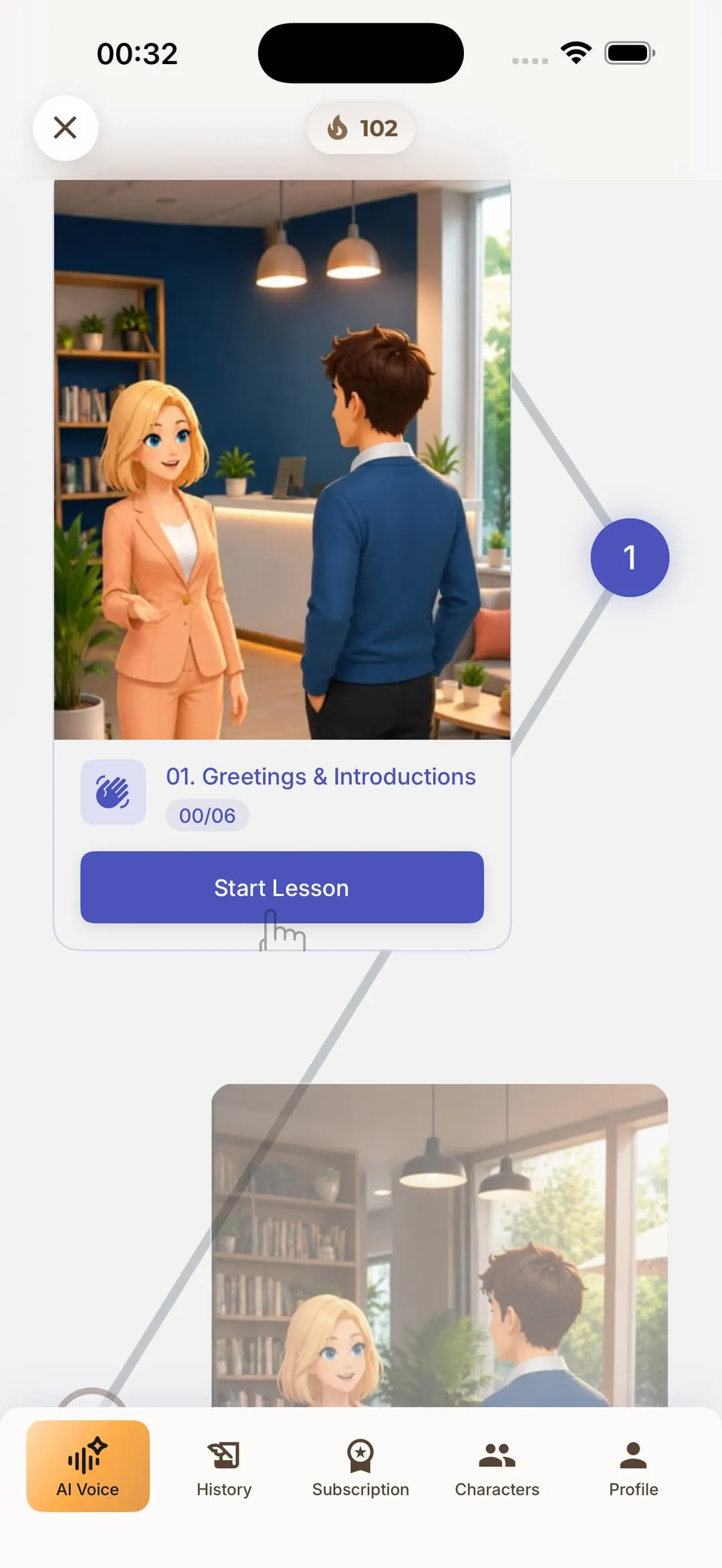
Tonight, pick three sentences you'll need this week. Listen, repeat, record. If you want somewhere to use those three sentences straight away, you can download Chamate and talk to the AI right now. If you'd rather learn step by step first, Chamate also has a full A1 to B2 path (see what's inside).
Frequently Asked Questions
Does the shadowing technique actually work?
Yes, mainly for listening and pronunciation. Hamada's 2016 study found that lower-proficiency learners improved clearly on a basic listening test after shadowing. But shadowing repeats sentences that already exist, so it doesn't build speaking reflexes on its own; for that you need real conversation.
How long should I practice shadowing each day?
About 10 minutes, since shadowing takes constant focus. Stay with the same three-to-five-sentence clip for three to five days before switching, rather than a new video every day.
Is shadowing good for beginners?
Yes, and beginners often benefit most. Start with pause-and-repeat on a short, slow clip with a transcript. Don't start with films or TED talks at full speed.
Do I need to understand the meaning when shadowing?
You should. Listening and looking up words before you shadow helps you remember the sentence so you can use it later. Shadowing sounds you don't understand still trains your ear, but leaves almost nothing for when you speak.
Can I practice shadowing with AI?
Yes. In Chamate you can replay any AI message and say it along, slow down the response speed, and use the “You can say:” suggestions, which can be read aloud, to hear a sample sentence and then use it in your reply. Chamate doesn't score pronunciation, so record yourself to compare.